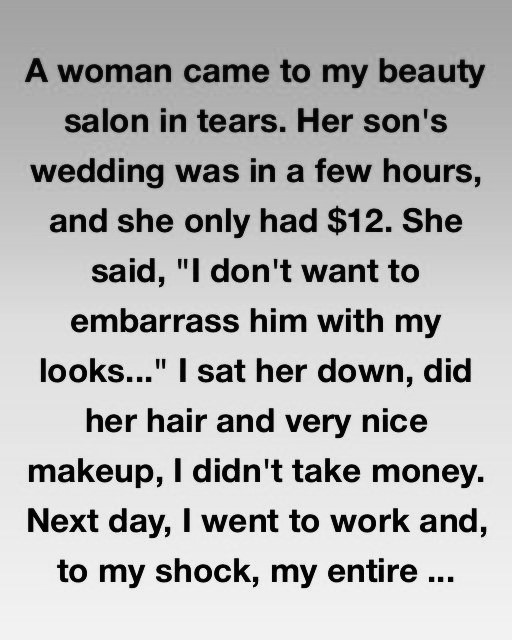
She walked into my salon just after sunrise, clutching a worn purse and carrying the unmistakable look of someone who hadn’t slept. Her eyes were red from crying, her shoulders hunched as if she were bracing for rejection. “My son’s wedding is in a few hours,” she whispered. “I don’t want to embarrass him.” She laid twelve dollars in crumpled bills on the counter and apologized before I could say a word. Her name was Mirela. I didn’t ask questions. I guided her to the chair and told her to sit. “Today,” I said, “we’ll make you feel like yourself again.”
As I worked, she slowly relaxed. I washed her hair, styled it in soft waves, and added just enough makeup to bring warmth back to her face. Watching herself in the mirror, she shook her head gently. “I used to look like this,” she said. “A long time ago.”
“You still do,” I told her. “You just forgot.”
When I turned the chair toward the mirror, she gasped softly. Tears filled her eyes—this time light, relieved. “I look like me again,” she whispered.
She tried to pay, but I refused. “You already did,” I said. “By trusting me.” The next morning, flowers covered the front of the salon. At the center was a small card: Thank you for seeing me. Weeks later, her son and new daughter-in-law came by. They told me Mirela had almost skipped the wedding, afraid she’d ruin the memories. That day, she stood tall and proud in every photo.
That moment changed everything.
Once a month, I began closing the salon to regular clients and opening it to those who needed care but couldn’t afford it. What started as one act of kindness grew into a nonprofit called The Mirror Project—built on dignity, not charity.
Mirela came in with twelve dollars.
She left having given me a purpose.
Leave a Reply